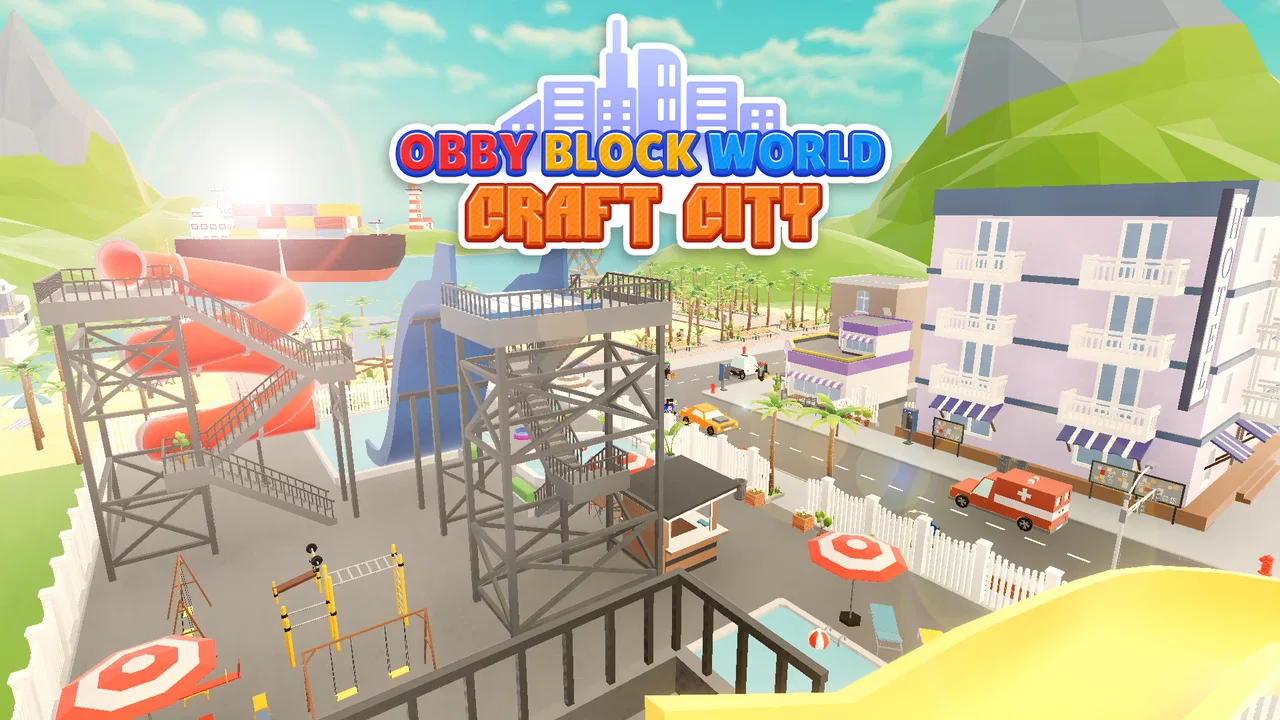
Obby Block World: Craft City
- 4.5
- Rating
- 1.00M
- Installs
- Free
- Price
 Analysis by App-foxy
I approached Obby Block World: Craft City as the sort of adventure game that can quietly become a shared-device favorite. The basic appeal is easy to understand: you move through a block-styled world, tackle obstacle-course challenges, and spend time shaping a city that feels like your own. What makes it more interesting than a quick obstacle game is the change of pace between action and creation. I can play actively for a while, then switch to arranging my world when I want something calmer.
That combination makes it suitable for short sessions, but it also changes how I judge it. This is not simply a game to hand to someone and forget about. On a household tablet or phone, the important questions are who is playing, whether everyone understands what belongs to them, and how much supervision is sensible for a Teen-rated adventure game. My experience is that the game works best when players treat the city as a personal project rather than assuming every person using the device has a separate, clearly divided space.
How the shared-device experience actually feels
On a device used by several people, the first attraction is obvious. One player may want to test movement and timing through the obby sections, while another may care more about building a recognizable little city. Those interests can coexist, but they do not automatically create separate play areas. I would set expectations before passing the device around: decide who is playing, agree not to change another person’s work casually, and make sure the next player knows what was being attempted.
You May Also Like

 Blood Strike: 2.5 Anniversary
Blood Strike’s Loadouts Turn Every Drop Into a Tactical Gamble
A close look at Blood Strike’s custom loadouts: how fast access to signature weapons reshapes its battle royale rhythm, rewards preparation, and narrows the gap between fights.

 Pandora - Music & Podcasts
Pandora’s Music Is Easy to Start, but Harder to Recover
Pandora’s strength is its low-effort path from a seed to a station. Its weak spot is how much confidence it asks you to place in connection, setup, and quiet recovery.

 8 Ball Pool
 Is Built on Rivalries, Rematches, and Routine
A close look at the rivalries, rematches, shared routines, and unanswered safety questions that turn a quick pool match into a persistent mobile community.

 Samsung Music
’s Quiet Strength Is Playing What You Already Own
Its reach comes less from spectacle than from dependable access to a personal library. That simplicity is both the app’s strongest retention engine and its ceiling.

 AccuWeather: Weather Radar
AccuWeather Review: A Quick, Clear Forecast for Everyday Decisions
For everyday plans, the best forecast is the one you can understand quickly. AccuWeather makes rain timing, radar, and local conditions easy to act on, with a few trade-offs.

 Hill Climb Racing
Why Hill Climb Racing Still Turns Crashes Into One More Run
A tiny car, a bumpy hill and one more upgrade: Hill Climb Racing keeps resurfacing because its simple chaos makes every near-miss feel personal.
More From Our News Desk



A realistic household session might look like this: one person spends a few minutes working through an obstacle route, then hands the device to a sibling or friend who adjusts the city. The handoff is smoother when the outgoing player explains what they changed and what they still want to do. Without that small conversation, a creative project can become confusing, especially when several people use the same world and each person remembers it differently.
I found the split between obstacle play and city creation useful for shared use because it gives players different ways to enjoy the same game. A competitive player can focus on completing difficult movement sections, while a more relaxed player can concentrate on visual organization. The trade-off is that the game does not remove the need for household coordination. It is better suited to cooperative ground rules than to an environment where every user expects automatic privacy or independent progress.
For a single player, this is less of an issue. I could follow my own rhythm and leave the city in whatever state I liked. On a shared phone, however, I would avoid treating the world as a communal sandbox unless everyone genuinely wants that. A simple rule such as “ask before rebuilding” prevents most frustration and makes the creative side feel rewarding instead of contested.
What to decide before installing
The game is free, which lowers the barrier to trying it on a household device. It comes from BMH Game and is listed as an adventure title, although its city-building element gives it a broader feel than a purely linear obstacle game. It was released on January 6, 2025, and the current version is 0.33. Those details matter less than the practical question of whether the device can run it comfortably and whether the person using it understands the shared-device arrangement.
Compatibility starts at Android 7.1, so the minimum operating-system requirement is not especially demanding. Still, meeting a minimum requirement does not guarantee that every older phone will feel equally comfortable during active play. Obstacle courses depend on responsive controls, and a player may notice delays or cramped touch controls more quickly during a precise jump than while arranging a city. I would test it briefly before promising it as a main game for a younger household member.
There is another boundary worth setting: decide whether the city is a personal creation or a family project. The game’s central fantasy encourages ownership, because building a world feels more satisfying when choices have meaning. If several people are going to edit it, I recommend agreeing on broad zones or turns. One person could handle roads and layout, another could focus on decorative choices, and another could play the obstacle sections without altering the construction area.
This is one of the more useful ways to avoid conflict without needing complicated arrangements. The game itself supplies the creative motivation, but the household supplies the organization. I would not assume that a shared device automatically means shared progress is safe from accidental changes. Before a first session, show each player which parts are already established and which parts are open for experimentation.
Balancing the obstacle courses with city creation
The strongest design choice, in my view, is the alternation between movement-based adventure and building. Obby sections ask for attention and patience. City creation invites planning and visual experimentation. If I fail repeatedly at a route, moving to the city gives me a way to stay engaged without turning the whole session into a test of reflexes. Conversely, if arranging blocks starts to feel repetitive, the obstacle side restores a sense of immediate purpose.
That balance also reveals the game’s main limitation. Players looking for a deep city simulator may find the building side more appealing as a creative layer than as a detailed management system. Players seeking a demanding platforming experience may prefer a game designed entirely around movement, timing, and level mastery. Here, neither side should be judged in isolation. The value comes from switching between them, not from expecting the title to replace a specialist game in either category.
I recommend using the city as a planning exercise rather than placing everything as quickly as possible. Leave clear routes between areas, keep a recognizable central space, and make changes in small batches when more than one person plays. This makes it easier to understand what each player contributed. It also reduces the common shared-device problem where a creative world becomes visually busy but difficult to navigate.
A second practical tip is to use obstacle play as a reset between building sessions. After a player has spent time making changes, a short return to the adventure side can reveal whether the city still feels enjoyable to move around in. That approach turns the two parts into a useful feedback loop: construction changes the setting, while movement helps judge whether the setting remains comfortable to use.
I would also encourage players not to treat every failed attempt as a reason to hand the device away immediately. In a household setting, watching someone try a section can be part of the fun, but it can also create pressure. Taking turns, explaining what went wrong, and allowing a retry keeps the experience more welcoming for players with different skill levels.
Coordination matters more than people expect
Because the game combines a personal-looking city with shared-device use, coordination deserves more attention than the store summary suggests. I would create a simple verbal handoff routine: say what was completed, identify the area that should not be changed, and mention the next intended task. This takes less than a minute and prevents a new player from mistaking unfinished work for a mistake.
For children or teens sharing with adults, I would make the rule even clearer: the person currently playing has control of the session, but not automatic permission to erase someone else’s project. That distinction sounds obvious, yet it is easy to lose when a game encourages constant building. A city can be collaborative only when collaboration is agreed upon.
Another useful arrangement is to give each player a role rather than a permanent claim. One session can focus on layout, another on obstacle practice, and another on reviewing the whole world. This avoids turning the device into a competition over who gets the “best” section. It also lets a less experienced player contribute meaningfully without having to complete the hardest movement challenges.
I would not use this game as a substitute for a communication-free multiplayer experience. Its shared value comes from the conversation around the screen, not from assuming the game will organize everyone’s boundaries for them. If your household wants completely independent saves, separate profiles, or strict account separation, you should check the actual in-game experience on the device before committing to it as a long-term shared activity.
Age context and trust
The content rating is Teen, so I would not frame this as an automatic choice for every child simply because the visuals are block-based. A bright, simplified art style does not by itself determine whether a game suits a particular player. I would consider the player’s maturity, comfort with challenge, and ability to follow shared-device rules. For a teen, the game can be a reasonable creative and reflex-based diversion. For a younger child, I would make the decision more deliberately and stay nearby during the first sessions.
Supervision here is less about assuming the game is unsafe and more about understanding how the device is being used. A parent or owner may want to know whether the city is being changed, whether the player is becoming frustrated by obstacle sections, and whether the game is being treated as a personal project or a communal one. Those are ordinary household concerns, but they matter because the game encourages ongoing creation rather than a single short round.
The game’s popularity can offer some reassurance that it has reached a substantial audience: it has more than a million installs and an average rating of 4.5 from roughly five thousand ratings. I see those figures as signs of interest, not as proof that every player will have the same experience. Ratings cannot tell me whether the controls suit a particular phone, whether a family prefers the building or obstacle side, or whether a shared-device routine will work in a specific home.
One detail I appreciate is that the game is free to try. That makes a supervised test session practical: install it, let each intended player try both major activities, and then decide whether it deserves a regular place on the device. I would pay attention to who keeps returning to the city, who prefers the obby sections, and who loses interest when progress requires repetition. That small trial is more informative than choosing based only on the title or screenshots.
Where it fits among similar choices
Compared with a dedicated obstacle-course game, this title offers more downtime and personal expression. You are not locked into a continuous sequence of jumps, so a missed attempt does not have to end the session. That makes it a better fit for players who like movement but also want to construct something. The compromise is that someone seeking highly focused platforming may find the city-building side distracting rather than enriching.
Compared with a traditional building sandbox, it adds a clearer adventure component. The obby structure gives players a reason to practice movement instead of only arranging blocks. The compromise works in the other direction: a player who wants extensive simulation, detailed resource systems, or a highly technical construction toolkit may prefer a more specialized sandbox. I would choose this game for accessible creative play with an active challenge, not for complex city administration.
That positioning is especially relevant on a family device. A specialist game may satisfy one person more deeply, but this one can bridge two preferences: the player who wants to do something and the player who wants to make something. It is not a perfect replacement for either type, yet it can be easier to share because the activities feel different without requiring separate games.
The rating count includes around twenty written reviews, so I would avoid treating the visible score as a complete account of every strength and weakness. My own judgement is more practical: the concept is appealing, the free entry point helps, and the combination has genuine replay value for the right player. The experience becomes less convincing when someone wants strict account boundaries, advanced city simulation, or a pure platforming challenge.
Who should try it, and who should skip it
I would recommend it to a teen who enjoys block-style worlds, likes alternating between action and creativity, and does not mind learning through repeated attempts. It also suits a household where people are willing to share a device thoughtfully. A parent looking for a low-commitment game to test with a teen can start with a short session and see whether the city-building project encourages constructive play or simply becomes another source of arguments over the screen.
I would be more cautious if the intended player needs separate progress with no chance of confusion, or if the household expects the game to enforce turns and ownership automatically. I would also look elsewhere for someone who wants a serious city-management experience or a demanding obstacle game with no creative detour. Those are not flaws in the same way for every player; they are signs that the game’s middle ground may not match the goal.
For everyday use, I think ten- to twenty-minute sessions work better than leaving the game open indefinitely. A short plan gives the player a concrete aim: complete a section, reorganize one area, or make one agreed change to the city. This keeps the shared device available to others and makes progress easier to explain during handoffs. It also reduces the chance that a player will make broad changes simply because they have been playing without a clear stopping point.
My household verdict
After looking at it as both an adventure game and a shared-device activity, I see Obby Block World: Craft City as a flexible choice with a clear audience. Its appeal comes from letting me move through obstacle challenges and then shape a block-based city, rather than forcing me to choose between action and creation. The free price makes experimentation easy, while the Teen rating means I would still make an age-appropriate decision instead of handing it to every child automatically.
The most important recommendation I can give is to establish boundaries before the first building session. Decide who owns the current project, whether edits are collaborative, and how players will hand the device over. Those small agreements do more for the household experience than trying to make everyone enjoy the same part of the game. When the rules are clear, the city becomes a shared conversation rather than a source of accidental frustration.
BMH Game has aimed for an approachable blend rather than a specialist simulation or a pure obstacle test. That makes the game easy to recommend to players who enjoy variety, but it also means expectations need to stay realistic. I would install it for a teen or family member who likes creative block worlds and short action challenges. I would skip it for someone who requires independent account spaces or wants deep systems in one narrow genre.
My final view is positive, with those boundaries attached. The game is at its best when players use the city as an evolving project, treat obstacle failures as part of the learning curve, and communicate before changing shared work. If that sounds like the kind of play your household can support, it is worth trying. If the device needs strict separation between users, choose an alternative built around individual profiles instead.
FAQs for Obby Block World: Craft City
01What is Obby Block World: Craft City?
Obby Block World: Craft City is a block-style adventure game that combines obstacle-course challenges with creative city exploration. Players move through colorful, Minecraft-inspired environments, jump across platforms, avoid traps, and discover different areas. Its simple controls and bright presentation make it accessible to younger players, while the changing layouts and challenges provide enough variety for casual gaming sessions.
02How do you play Obby Block World: Craft City?
Gameplay mainly focuses on guiding your character through obstacle courses without falling or hitting dangerous objects. You need to time jumps, move carefully across narrow platforms, and learn from failed attempts. The game is easy to understand because its controls are generally straightforward, but some sections require patience and accurate movement. Exploring the block-built city can also add variety between challenges.
03Is Obby Block World: Craft City suitable for children?
The game is generally suitable for children because it uses cartoon-style graphics, non-realistic action, and simple platforming mechanics rather than intense violence. However, parents should still review the app-store age rating, advertising policy, and any in-app purchase information before installation. Depending on the version and device, the game may include ads or external links, so parental supervision is recommended.
04Does Obby Block World: Craft City require an internet connection?
The basic obstacle-course experience may work without a constant internet connection, but this can depend on the version installed and the features included by the developer. Advertisements, updates, online content, or other connected services may require access to the internet. If you plan to play offline, it is best to test the game after installation and check its store description for current requirements.
05Is Obby Block World: Craft City free to download?
Obby Block World: Craft City is typically offered as a free download, although availability and pricing can vary between Android and iOS stores or by region. Free access may be supported by advertisements, and some versions could include optional purchases or additional content. Before downloading, check the official store listing for the latest information about ads, permissions, purchases, storage space, and supported devices.
Pros
- Creative block-building encourages imagination and open-ended play.
- Obstacle courses provide simple challenges for casual gaming sessions.
- Bright 3D visuals make the city easy to explore and navigate.
- Offline play is useful when you have no internet connection.
- Suitable for players who enjoy sandbox-style environments and parkour.
Cons
- Controls may feel imprecise during jumps and narrow platform sections.
- Repetitive obstacles can reduce long-term replay value.
- The game may contain frequent ads between activities or levels.
- Limited customization can make the world feel less personal over time.
- Performance may vary on older phones with lower-end hardware.

Obby Block World: Craft City
Gallery